
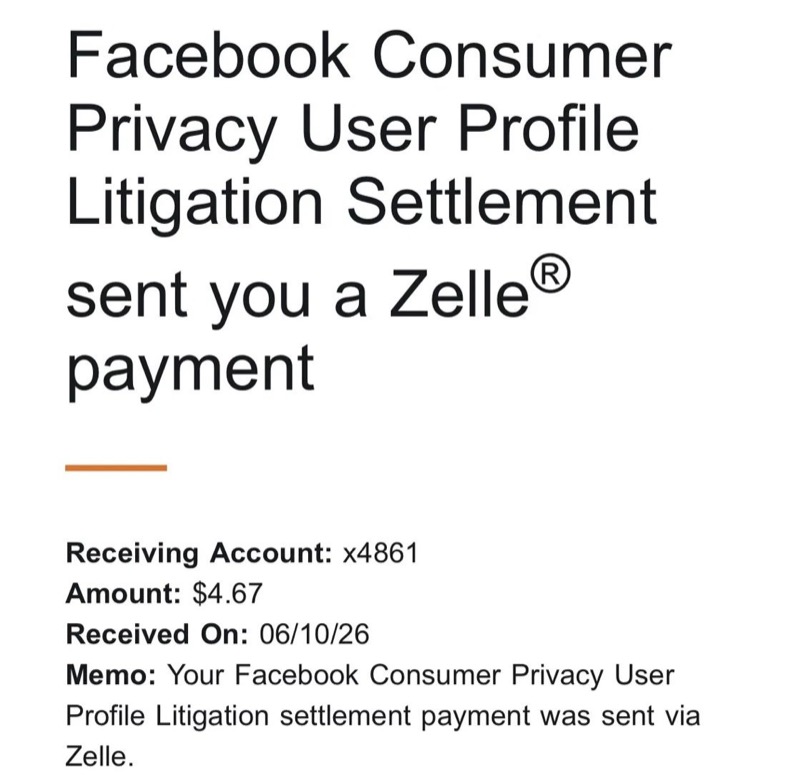
$4.67
$4.67.
That’s what Facebook owes me for years of harvesting my personal data, building shadow profiles, sharing information with third parties without meaningful consent, and running one of the most sophisticated behavioral surveillance operations in human history.
Four dollars and sixty-seven cents. Sent via Zelle.
I’ve spent years on the other side of this problem. Building privacy programs, assessing third-party risk, designing controls that actually protect people’s data. I’ve sat in rooms and argued that privacy is a fundamental right and not a compliance checkbox. I’ve read FTC consent decrees and tried to pull something useful out of them.
And my cut is $4.67.
The math is the message
The Facebook Consumer Privacy User Profile Litigation settlement totaled $725 million. Sounds significant until you put it next to Meta’s 2023 revenue of $134 billion. The settlement is roughly half a percent of a single year’s top line, for a company that spent the better part of a decade doing exactly what it was sued for.
Put it another way. $725 million is about two days of Meta’s revenue. Two days to settle a decade of conduct.
Payouts ranged from $2.52 to $10 depending on how many claims got filed. That spread isn’t an accident of math. It’s the designed output of a system built to clear legal liability at the lowest defensible cost. The attorneys get paid. The named plaintiffs get a bump. Everyone else gets a Zelle notification and a number that rounds to nothing.
Consent decrees don’t change behavior
I’ve read enough FTC consent decrees to know what they actually produce: paperwork obligations and audit rights. They don’t restructure incentives. They don’t size penalties to harm. They don’t make it economically irrational to do the thing that triggered them in the first place.
Facebook has been under FTC scrutiny for more than a decade. The 2012 consent order. The 2019 settlement of $5 billion, the largest in FTC history at the time, which didn’t even require an admission of wrongdoing. And here we are in 2026 with another settlement, another round of Zelle payments, and the same company running the same business model it ran the whole time.
$5 billion sounds like accountability until you remember it was a fraction of one year’s profit, and the stock went up the day it was announced because investors were relieved the number wasn’t bigger.
The penalty was priced in before the gavel came down. It was cheaper than stopping.
The fine is a line item
If you make decisions about risk for a living, this outcome should bother you for reasons past the insult of the payout.
Somewhere inside Meta, years ago, someone modeled this. Not the exact dollar figure, but the shape of it. Regulatory exposure, litigation probability, expected settlement range, timeline. Then they weighed it against the revenue the data practices generated and made a call. The math favored building. So they built.
That isn’t a villain twirling a mustache. That’s a competent operator running a cost-benefit analysis and landing on the rational answer. The conduct continued because the expected cost of the conduct was lower than the expected return. The fine wasn’t a deterrent. It was a budgeted expense.
This is the part that should worry anyone building a company. The enforcement regime we keep promising consumers, the one where the cost of non-compliance climbs high enough to change behavior, mostly doesn’t exist. GDPR has more teeth and slow, uneven enforcement. State privacy laws in the U.S. keep multiplying and stay fragmented. The federal framework we’ve debated for twenty years still hasn’t shipped.
The companies that built their models on data extraction are still building. The incentives haven’t moved. The tooling got better. The scale got larger.
I got priced in too
Here’s the uncomfortable part. I know exactly how this works and I filed the claim anyway.
I filed because the marginal effort was near zero and the principle mattered to me. I wanted to be counted. I wanted the pool to be slightly larger because one more person showed up. I did the thing the system asked me to do, the same way Meta did the thing its model told it to do.
Two rational actors, same kind of calculation, very different outcomes. They modeled their downside and budgeted for it. I modeled my upside and got $4.67 in my checking account, with a Zelle receipt to mark the occasion.
They were just better at the math.
Until that math changes, until the penalties land large enough, fast enough, and certain enough to move the calculus before the conduct starts, we keep having this conversation. Different company, different data set, same payout.
File your claims. Push for stronger policy. Back the people working on real enforcement reform.
Just don’t expect a check that covers lunch.